Across the construction and infrastructure sectors, structural and geospatial monitoring has long been treated as a compliance exercise – a box to be ticked on a method statement before the real work begins. That perception is changing fast.
Tantek 4D established a dedicated Monitoring Division to meet the growing technical demands of modern construction, infrastructure, and asset management projects. The division delivers a comprehensive, full-package monitoring service, built around rigorous quality control and a clear philosophy: monitoring is not a defensive, last-minute safety measure or a bureaucratic formality. It is a critical pillar of project success.
Whether the requirement is monitoring a major infrastructure development or assessing an isolated, high-stakes risk such as a landslide threatening a residential property, a well-designed monitoring regime is what keeps projects moving forward safely, legally, and on budget.
Proposing Solutions, Not Just Hardware
Successful monitoring is never a one-size-fits-all service. Understanding the precise capabilities of the available instrumentation – from automated total stations to geotechnical sensors – is what allows the right solution to be proposed for each client, rather than a default or generic package.
Tantek 4D’s approach avoids both over-engineering and cutting corners. Taking the time to understand the specific scope, risk profile, and constraints of a site allows the team to design and deliver a solution that is technically robust, fully compliant, and realistic for the client’s budget.
The Lifespan of Care: From Construction to Operation
Engineering risks do not disappear once construction is complete. True asset protection requires a lifecycle approach:
- Construction Phase: Protecting adjacent structures, tracking real-time displacements during excavation or piling, and ensuring temporary works perform exactly as engineered.
- Operational Phase: Long-term asset health monitoring, ensuring infrastructure – whether a bridge, tunnel, or commercial facility – settles and behaves predictably over its operational lifespan, safeguarding public safety and long-term capital investment.
The Four Pillars of a Reliable Monitoring Regime
Delivering data that stakeholders can trust requires a rigorous, repeatable process. Every monitoring campaign at Tantek 4D is built on four core principles.
1. Meticulous Planning and Defined Boundaries
Establishing clear trigger levels (Green/Amber/Red) and emergency action plans is fundamental to any project. These thresholds should be calculated and defined by the project’s consulting, structural, or civil engineers – not assumed by the surveying team. Separating technical measurement from structural engineering liability ensures the monitoring data empowers the certified authorities to make informed decisions, keeping the project compliant and legally secure.
2. Intelligent Instrumentation Selection
Choosing the right tool for the specific environmental and structural conditions of a site is where expertise saves a client time and money. A common industry trap is over-engineering a solution – for example, installing hundreds of dense, manual levelling points when a targeted, automated approach would capture better data in a fraction of the time. Tailoring the instrumentation precisely to the scope eliminates unnecessary installation materials, reduces manual survey hours, and ensures the client receives actionable insights without paying for redundant data points.
3. Pre-Analysis, Calibration, and Testing
In high-precision monitoring, there is no room for unverified data. Before any equipment arrives on site, it undergoes comprehensive pre-analysis, internal calibration, and baseline testing. Standardised QA/QC workflows ensure that every sensor, total station, or data stream is functioning correctly before the first reading is taken.
4. High-Accuracy Execution
The best equipment is only as good as the people operating it. Tantek 4D’s field operations are carried out by qualified surveyors holding Bachelor’s and Master’s degrees from dedicated surveying universities, supported by industry credentials including Chartered Institution of Civil Engineering Surveyors (CICES) membership. The team’s academic foundation is paired with decades of tier-one project experience across the wider Tantek 4D leadership, ensuring every survey is executed to the highest standard.
Driving Efficiency Through Automation
Capturing accurate data is essential, but in a fast-paced construction environment, speed is what empowers decision-makers. The industry is moving away from manual, intermittent readings toward automated workflows.
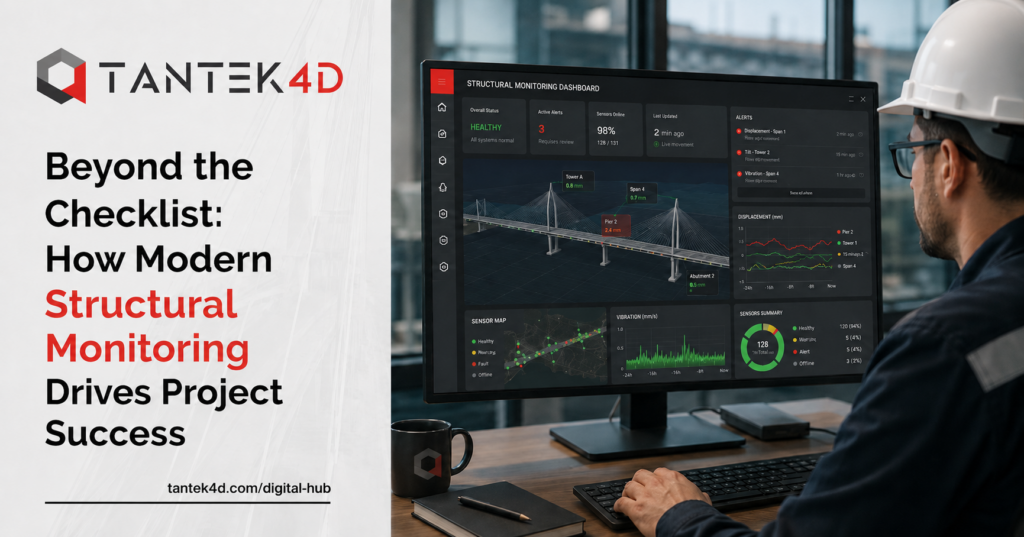
By using automated instrumentation linked directly to cloud-based data hubs, site data is transmitted securely from the field to an online platform in near real time, rather than waiting days for manual reports. When a structural movement or environmental threshold is breached, automated systems send instant alerts to engineering teams and stakeholders – shifting site management from reactive troubleshooting to proactive control.
The Real Cost of Delayed Monitoring: Reactive vs. Proactive
Monitoring solutions are often deployed late in a structure’s lifespan, in response to issues that originated years earlier during planning, geotechnical studies, or construction.
When a floor begins to deflect, or structural cracks appear years after completion, diagnosing the issue becomes a complex, disruptive, and expensive process. It typically requires bringing in specialists to assess the building’s current condition, install retrospective monitoring, and reverse-engineer the cause of the failure. Stakeholders are then left with a difficult choice: invest in uncertain remedial works, or consider relocating from the asset entirely.
Implementing precise monitoring from the early stages of a project changes this outcome. Early-stage data acts as an early warning system, identifying structural and geotechnical shifts long before they become visible defects. Catching a micro-movement during construction is significantly cheaper and simpler to address than remediating a failing building years later. Proactive monitoring is not an additional cost – it is a financial safeguard.
Partnering for the Future
Geospatial and Monitoring technology continues to evolve quickly, which is why Tantek 4D works closely with leading equipment suppliers and industry specialists to stay at the forefront of best practice.
Monitoring has moved well beyond a compliance checkbox. It is now an active contributor to structural integrity, financial risk mitigation, and public safety. By combining hands-on field expertise, a highly credentialed team, and Tantek 4D’s reputation for digital innovation, the Monitoring Division supports clients in safeguarding the built environment throughout the project lifecycle.
Get In Touch
Whether you have a live project that needs a robust monitoring strategy, or a technical question about how modern instrumentation works, we want to hear from you.
Contact our team today to start a conversation.